Sustainability Management
Sharp’s Sustainability Policy
Basic Philosophy on Sustainability
It has been our business philosophy since our founding to “contribute to the culture, benefits and welfare of people throughout the world,” “to grow hand-in-hand with our employees, encouraging and aiding them to reach their full potential and improve their standard of living,” and to understand that “our future prosperity is directly linked to the prosperity of our customers, dealers and shareholders.” Based on this business philosophy, we have continued to meet the expectations and requirements of society and our stakeholders, and these aspirations for sustained mutual growth of the company and society are maintained as our basic philosophy on sustainability.
System for Sustainability Policy

Sharp Group Charter of Corporate Behavior and the Sharp Code of Conduct
To concretize our business philosophy and business creed, we have set out the Sharp Group Charter of Corporate Behavior to serve as the principles of behavior for Sharp Group companies, and the Sharp Code of Conduct to serve as a standard for all directors and employees. We work to ensure that these guidelines permeate the Group as fundamental sustainability policies, and that the Group takes appropriate and sincere action in all of its business endeavors with a high ethical standard and full compliance with the law.
Resolutions regarding the adoption of the Sharp Group Charter of Corporate Behavior and the Sharp Code of Conduct are issued by the boards of directors of Sharp Corporation and its main subsidiaries and affiliate companies in Japan and overseas. At overseas subsidiaries and affiliates, these documents are translated into local languages so that employees can fully understand and comply with them.
The content of the Sharp Group Charter of Corporate Behavior and the Sharp Code of Conduct is reviewed each year to determine if revisions need to be made.
Participation in the RBA
In December 2021, we joined the Responsible Business Alliance (RBA) to further fulfill our social responsibility in our global supply chain in line with international standards.
The Sharp Group shares the RBA’s vision and mission group-wide, and uses the RBA Code of Conduct, formulated by the RBA, as a concrete guideline for its own efforts to identify and address risks at its, and its suppliers’, factories.
Ensuring Adherence to the Sharp Code of Conduct
To deepen understanding of the Sharp Code of Conduct and ensure that all executives and employees act in accordance with it, compliance-related e-learning based on the Sharp Code of Conduct is held every year in Japan.
In fiscal 2025, this training was open to 16,751 employees, including those at Sharp Corporation, subsidiaries in Japan, and the labor union, with 16,482 taking part (98.4% participation rate). The training covered a range of areas: conducting business activities in line with the Sharp Code of Conduct, raising awareness of the whistleblowing system, business and human rights, compliance, information security, customer satisfaction, and product safety. We also spread knowledge about the Sharp Code of Conduct at overseas bases. This included distributing e-learning materials as part of efforts to ensure understanding globally at Sharp.
The compliance training will continue to be held and expanded in content with the goal of ensuring that employees have a better understanding of compliance and fostering awareness for potential problems and ways to prevent them. The training is held as an in-house measure based on the Basic Policy for Internal Control. Training results are reported to the Internal Control Committee, which is chaired by the president & CEO, and to the Board of Directors.
Education on Sustainability for Employees
We provide annual e-learning courses on ESG for all employees of group companies in Japan. The aim is to ensure that each and every employee understands sustainability as their own responsibility and incorporates it into their daily work.
In fiscal 2025, we expanded the program to include topics such as carbon neutrality, circular economy, biodiversity, DEI, and LGBTQ+ issues, in addition to fundamental themes like the Sharp Group’s sustainability basic strategy. The program was open to 17,908 employees, including those at Sharp Corporation, subsidiaries in Japan, and the labor union, with 14,552 completing the course (81.3% participation rate).
Following the training, we conducted a test and questionnaire to gauge how well the participants understood the program. In the questionnaire, 76.8% of employees responded that they “always consider ESG in their daily work” or “sometimes consider ESG in their daily work.” Both the participation rate and the percentage of people giving these responses have increased over the previous year, indicating that the concept of sustainability is becoming more deeply ingrained within the company.
To support this broader understanding of sustainability within the company, we publish a monthly ESG newsletter on our intranet. It presents a wide range of ESG and sustainability-related topics in an easy-to-understand format. By combining e-learning opportunities with regular information sharing, we aim to promote understanding and encourage employees to put that understanding into action.
We will continue to provide education on sustainability while expanding opportunities and topics to ensure the concept of sustainability is ingrained companywide.
Sustainability Strategy and Implementation System
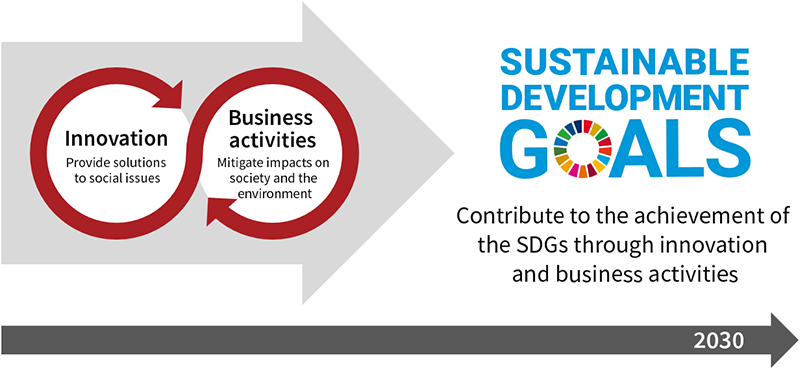
In line with our basic philosophy towards sustainability, we have positioned our role to contribute to the achievement of the Sustainable Development Goals (SDGs)—adopted by the UN in September 2015 with major expectations placed on corporations—in our medium-to long-term vision, and are moving forward with those efforts.
In fiscal 2018, to accelerate efforts toward this medium-to long-term vision, we established a fundamental strategy of proceeding with a sustainable management approach aimed at achieving the SDGs. The strategy takes a two-pronged approach: creating solutions to social problems through business and technological innovation, and reducing social and environmental impact through sustainable business activities.
Through these efforts, we aim to solve the various social issues facing us today, such as realizing a low-carbon world, solving medical and nursing care problems, eliminating labor shortages, and realizing a diverse range of lifestyles. In the process, we will create value that is uniquely Sharp while being committed to our founding spirit set down in our business philosophy and business creed.
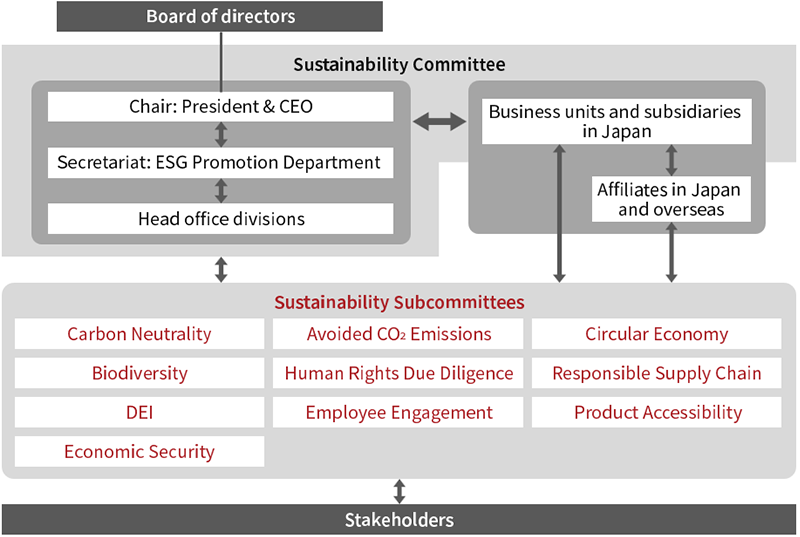
To execute these strategies and manage them in a PDCA cycle, we launched the Sustainability Committee, which is chaired by the president & CEO of Sharp and comprises members of top management, head office divisions such as environment, personnel, and procurement, business units, and subsidiaries. The committee ingrains policies and visions into the Sharp Group, discusses crucial measures, shares the latest trends in social issues, and reports important policies and decisions to the Board of Directors. To accelerate its efforts, we set up sustainability subcommittees in fiscal 2024, each focused on specific sustainability issues.
We will continue to step up efforts in the SDGs and ESG and improve our ESG rating, while at the same time building a solid management foundation to support sustained growth and contributing to the realization of a sustainable society.
Fundamental Strategy of Sustainable Management
Organization for Sustainability Management (As of September 2026)
Participating in Various Initiatives
As a member of the global community, we conduct business in way that respects international guidelines and norms.
United Nations Global Compact
We became a signatory to the United Nations Global Compact in September 2009.
We carry out measures in line with the Global Compact’s 10 principles in the four areas of human rights, labor, the environment, and anti-corruption.
RBA (Responsible Business Alliance)
In December 2021, we joined the RBA, an alliance of companies that pursues social responsibility across the global supply chain. We endorse the RBA vision and mission.
RMI (Responsible Minerals Initiative)
Since December 2021, we have been a member of the RMI, an international initiative for the responsible sourcing of minerals. We actively pursue due diligence in our procurement of minerals.
JaCER (Japan Center for Engagement and Remedy on Business and Human Rights)
In October 2022, we joined JaCER, which provides a platform for addressing grievances in accordance with the United Nations Guiding Principles on Business and Human Rights, and are working to establish mechanisms for addressing grievances within the global supply chain.

Other groups we are a member of:
- Keidanren (Japan Business Federation)
- JEMA (Japan Electrical Manufacturers’ Association)
- JEITA (Japan Electronics and Information Technology Industries Association): CSR Committee, Responsible Minerals Trade Working Group, etc.
- JBMIA (Japan Business Machine and Information System Industries Association): Responsible Corporate Behavior Committee, etc.
- JMC (Japan Machinery Center for Trade and Investment)
- JPEA (Japan Photovoltaic Energy Association): CSR Working Group, etc.
TCFD (Task Force on Climate-related Financial Disclosures)
In August 2022, we declared our support for the TCFD recommendations. We are expanding and improving the disclosure of information related to climate change, in accordance with the framework set by the TCFD.

RE100
In February 2025, we joined the RE100, a global initiative that aims to have businesses use 100% renewable energy in their operations. We will push forward with the use of renewable energy and contribute to a low-carbon economy.
SBTi (Science Based Targets Initiative)
In March 2024, we were certified for SBT 1.5°C. This was a recognition that our targets for reducing greenhouse gas emissions are based on science and conform with the Paris Agreement. In May 2026, we updated these targets to more ambitious ones aligned with our decarbonization plan.
GX Future Consortium
In April 2026, we joined the GX Future Consortium. By collaborating with a diverse range of stakeholders, we are working to create demand and ensure smooth financing for green transformation (GX), helping to achieve a virtuous cycle of decarbonization and economic growth.
Industry-Government-Academia Partnership on Circular Economy
In December 2023, we joined the Industry-Government-Academia Partnership on Circular Economy (Circular Partners), which is organized by the Japanese Ministry of Economy, Trade and Industry. Our aim is to deepen collaboration between industry, government, and academia that will lead to the realization of a circular economy.
TNFD (Taskforce on Nature-related Financial Disclosures) Forum
In August 2024, we joined the TNFD Forum in support of the TNFD’s mission and actions. In March 2026, we registered as a TNFD Adopter, declaring our commitment to disclosures in accordance with the TNFD framework. We will further expand our disclosure of nature-related information.

30by30 Alliance for Biodiversity
In June 2024, we joined the 30by30 Alliance for Biodiversity organized by the Japanese Ministry of the Environment. The aim is to help achieve the 30by30 goals by expanding efforts to conserve biodiversity and realize a sustainable society through our business activities and environmental and community service activities.

Material Issues
Identifying and Monitoring Material Issues
A succession of international long-term goals that seek solutions for social issues at the global level, such as the SDGs and the Paris Agreement*, have been announced, and there is a growing interest in human rights issues such as forced labor in global supply chains. As such, expectations continue to grow for companies to put forth an effort to address these goals and issues.
Against this backdrop, we are identifying material issues for the sake of sustainable management with a view to solving global-level social issues and achieving medium-to long-term growth for the Sharp Group.
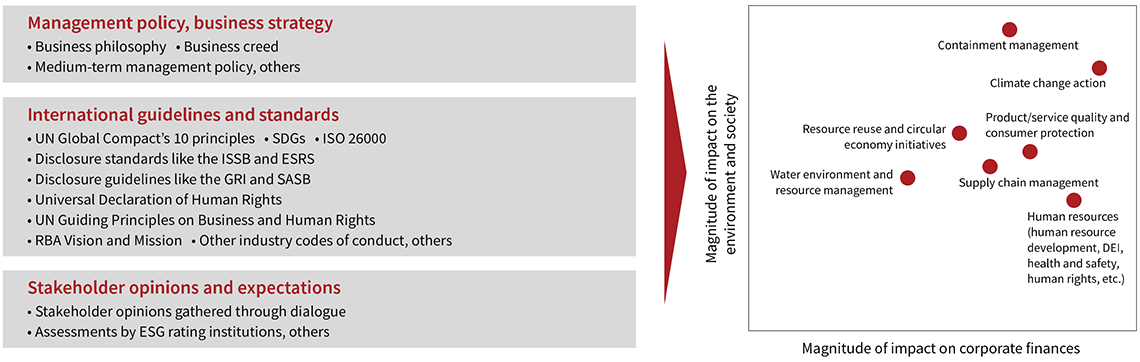
In identifying material issues, we took into account our business philosophy, business creed, and medium-term management policy. We also considered international guidelines and principles such as the UN Global Compact, the SDGs, and the RBA vision and mission, as well as international non-financial disclosure standards such as the GRI (Global Reporting Initiative), SASB(Sustainability Accounting Standards Board), ISSB (International Sustainability Standards Board), and ESRS (European Sustainability Reporting Standards).
We also considered the opinions and expectations of various stakeholders and the results of assessments by ESG research and rating institutions. The material issues uncovered were used to identify priority topics to be addressed company-wide from the two standpoints of “magnitude of impact on the environment and society” and “magnitude of impact on corporate finances.”
For the priority topics identified, measure-specific targets, goals, KPIs, and action plans are established. The implementation and results of these are reviewed at the twice-a-year meetings of the Sustainability Committee and the sustainability subcommittees, as well as at other meetings company-wide.
Furthermore, we continuously review the appropriateness of our material issues in light of changes in the social and business environment, as well as the expectations and requests of our stakeholders. Currently, we are reviewing our material issues in light of the external environment surrounding sustainability and changes in the Sharp Group’s business strategy, and we will continue to appropriately update them as needed.
- An international framework for the prevention of global warming agreed on at the 21st yearly session of the Conference of the Parties to the 1992 United Nations Framework Convention on Climate Change (COP21), held in Paris in 2015. The agreement was to hold the increase in the global average temperature to well below 2°C above pre-industrial levels.
Process for Identifying Material Issues
| Material issue (priority topic) | Priority initiative | KPI | Deadline |
|---|---|---|---|
| Climate change action | Reduce greenhouse gas emissions associated with business activities | Achieve net zero CO2 emissions from Sharp business activities | FY2030 |
| Reduce greenhouse gas emissions by 55.5% (baseline year: fiscal 2021) | FY2026 | ||
| Resource reuse and circular economy initiatives | Pursue a circular economy for products (reduce use of virgin plastics) | Percentage of products using recycled plastics or bioplastics among new products for the reporting year: At least 70% | FY2030 |
|
FY2026 | ||
| Containment management | Reduce waste associated with business activities | Final landfill disposal rate of less than 0.5% | FY2026 |
| Reduce VOC (volatile organic compound) emissions | VOC emissions into the atmosphere: 204 tons or less (baseline year: fiscal 2010) | FY2026 | |
| Water environment and resource management | Improve water intensity | Improvement rate of water intensity: 10% (baseline year: fiscal 2021) | FY2026 |
| Human resources (human resource development, DEI, health and safety, human rights, etc.) |
|
Have at least 3,200 people participate in the AI/digital engineer reskilling program | FY2027 |
|
FY2026 | ||
| Promote action plan in line with the Act on the Promotion of Women’s Active Engagement in Professional Life | Have at least 15% of new graduates hired for engineering jobs and 50% of new graduates hired for non-engineering jobs be women | FY2029 | |
| Have at least 7.5% of managers be women | FY2029 | ||
| Have at least 95% of female employees having returned to work after taking childcare leave stay at Sharp beyond 12 months after their reinstatement | FY2029 | ||
| Raise employment rate for people with disabilities | 2.7% employment rate for people with disabilities | FY2026 | |
| Eliminate severe accidents, reduce workplace accidents | Number of workplace accidents: Continue to meet the FY2025 target (51 cases or less) Number of lost-time accidents: Continue to meet the FY2025 target (12 cases or less) |
FY2026 | |
| Implement company-wide Healthy Sharp initiative | FY2026 | ||
| Prevent health problems caused by overwork | FY2026 | ||
| Improve employee engagement | Engagement score: A (up 3 ranks compared to FY2024) | FY2027 | |
| Promote human rights due diligence | Sharp plants’ ESG self-assessment survey score: All sites score higher than the previous year’s score | FY2026 | |
| Product/service quality and consumer protection | In order to provide customers with attractive product value and deliver corporate value, strengthen efforts focused on improving customer satisfaction, improving market quality, and reducing compliance risks | FY2026 | |
| Increase customer satisfaction | Customer satisfaction rate 90.0% or higher | FY2026 | |
| Supply chain management | Continue CSR/green procurement survey | Response rate 100% | FY2026 |
| Provide ESG education for procurement staff | Participation rate 100% | FY2026 | |
| Promote responsible mineral sourcing | Percentage of CMRT-conformant smelters/refiners (conformance rate): 65% or higher | FY2026 | |
ESG Risk Evaluation in Line with International Standards
As a globally operating company, Sharp recognizes that continuously assessing ESG risks in its production activities against international standards and using the results to drive improvements is crucial for achieving both business growth and a sustainable society. In particular, in the electronics industry, in addition to the environmental performance of products, the management practices related to labor, health and safety, environment, and ethics at manufacturing sites and within supply chains are an important evaluation point for customers, investors, business partners, certification bodies, and others.
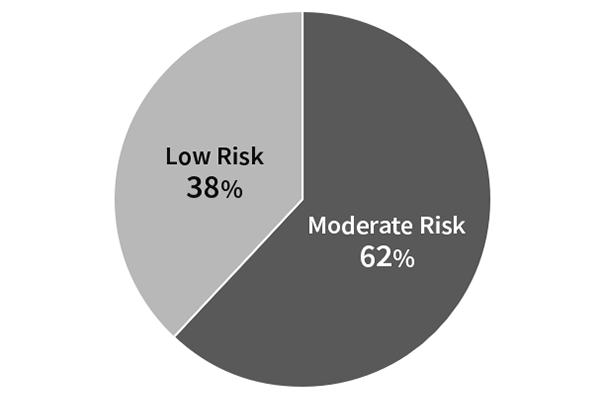
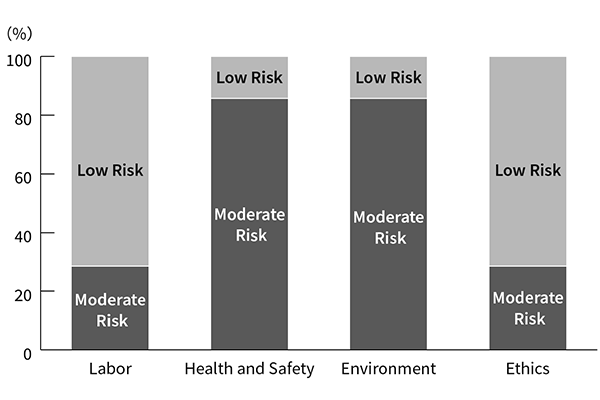
Since fiscal 2015, we have been using the RBA Code of Conduct, an international standard, as the guideline for the Sharp Group’s actions, and we have been carrying out ongoing self-assessment surveys of all production sites in Japan and overseas. These surveys, which are carried out based on the RBA’s Self-Assessment Questionnaire, are used to check the status of initiatives in the areas of labor, health and safety, environment, and ethics, and to assess the risks of each plant according to three levels: low risk, moderate risk, and high risk.
In fiscal 2025, the survey was carried out at all 21 plants in Japan and overseas, and it had a 100% response rate. The survey results were relayed back to each plant in the form of an overall and area-specific evaluation, and they are being used to facilitate local personnel’s better understanding of international standards and to establish improvement activities.
As a result of the survey, no issues posing significant immediate risks to the Sharp Group as a whole were identified. Survey responses from the plants are reviewed by relevant head office departments. If it is determined that a plant’s efforts are inadequate or latent risks exist, the plant in question is interviewed and provided with guidance for undertaking continuous improvement activities.
In addition, since fiscal 2023, to enhance the objectivity and transparency of ESG risk assessments, major production sites have been undergoing VAP* audits by the RBA. In fiscal 2025, three plants in Thailand, China, and France underwent VAP audits. The plants have implemented corrective measures for the issues identified during the audits. By utilizing third-party audits, we are incorporating external perspectives in addition to self-assessment, thereby improving management standards at each of our locations.
We will continue to enhance our ESG risk management, building on risk assessments of our own plants based on the RBA framework. Going forward, we will continue to conduct self-assessments and third-party audits, implement improvement activities based on the assessment results, and strengthen our responsible manufacturing system to earn the trust of our stakeholders.
- Validated Assessment Program. A VAP audit is an on-site audit conducted by an RBA-approved third-party audit firm.
Status of ESG Risk Assessment Implementation
| FY2023 | FY2024 | FY2025 | |
|---|---|---|---|
| ESG risk assessment target plants (all plants in Japan and overseas) |
27 plants | 26 plants | 21 plants |
| Plants conducting self-assessment surveys | 27 plants (100% response rate) |
26 plants (100% response rate) |
21 plants (100% response rate) |
| Plants undergoing RBA VAP audits | 4 plants | 6 plants | 3 plants |
Fiscal 2025 Self-Assessment Survey: Overall Assessment Results
Fiscal 2025 Self-Assessment Survey: Distribution of Area-Specific Assessment Results
Stakeholder Engagement
Stakeholder Engagement
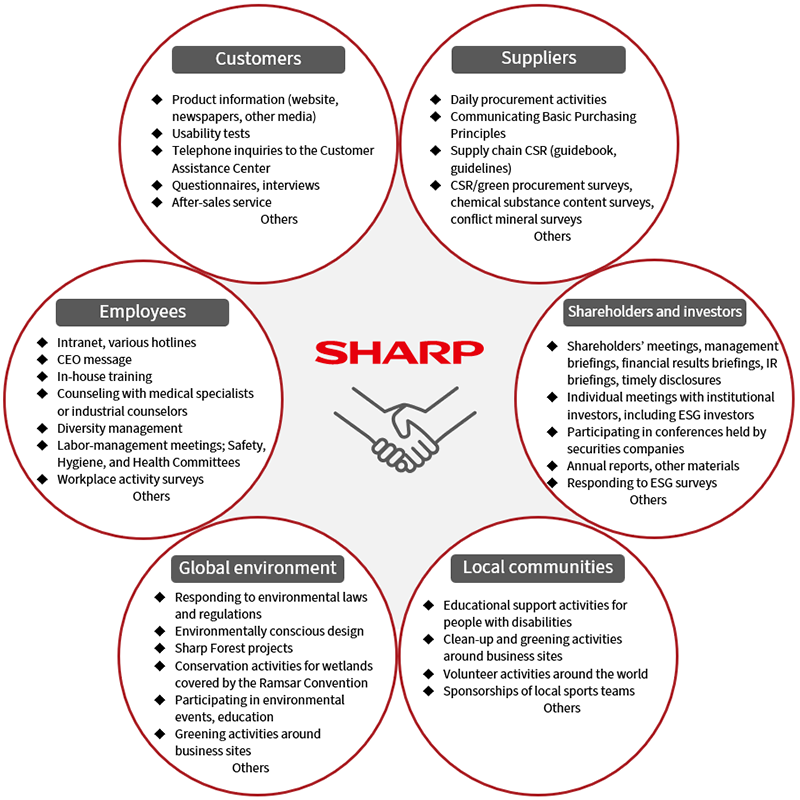
In order to ensure that “Our future prosperity is directly linked to the prosperity of our customers, dealers and shareholders,” as stated in our Business Philosophy, we suitably disclose information to the diversity of stakeholders that we serve, including customers, suppliers, and local communities.
Also, amidst the increasing focus on ESG-related investment, we strive to improve our ESG level by creating a range of opportunities for dialogue with shareholders and investors.
We will continue to reflect stakeholder opinions in our corporate activities with the goals of helping society solve problems and achieving sustainable growth for Sharp.