Efforts Related to Human Rights
Efforts Related to Human Rights
Guiding Principles on Human Rights
As a participant in the United Nations Global Compact, we promote initiatives that conform to international principles about human rights and labor standards, such as those advocated in International Labour Organization (ILO) conventions.
Our fundamental policies with regard to human rights are embodied in the Sharp Group Charter of Corporate Behavior and the Sharp Code of Conduct. These stipulate that the Sharp Group respects fundamental human rights and individuality by eschewing practices that are discriminatory or which infringe upon human rights, such as child labor or forced labor, and every effort is made to ensure that all Sharp employees are aware of and adhere to these policies.
The Sharp Group Human Rights Policy has been established as a document outlining the Sharp Group’s basic principles and commitment regarding respect for human rights, with the aim of ensuring equal and fair treatment of all stakeholders and of realizing a sustainable society free of human rights violations.
Human Rights Education and Training
In Japan, new employees and mid-career hires of the Sharp Group learn about Sharp’s philosophy on human rights by studying the Sharp Group Charter of Corporate Behavior and the Sharp Code of Conduct.
Each site carries out ongoing human rights awareness activities, including annual human rights training. In fiscal 2025, we held online training and e-learning on preventing all forms of harassment, as well as on other important topics. A total of 15 sessions were provided to 13,337 employees.
In fiscal 2025, ESG-related training encompassing such topics as the impact of corporate activities on human rights and human rights risks that should be considered was also provided to all Sharp Group employees in Japan. This training was open to 17,908 employees, including those at Sharp Corporation and subsidiaries in Japan, with 14,552 taking part (81.3% participation rate).
Sharp Group Charter of Corporate Behavior (excerpt)
The Sharp Group does not sanction child labor or forced labor.
Sharp Code of Conduct (excerpt)
- We respect the fundamental human rights and the dignity of individuals in all business activities, and will not be complicit in human rights violations. In case business activities, products and services are found to adversely affect human rights, we will take all appropriate measures.
- We will not sanction child labor or any form of forced labor, and we will support its effective abolition.
- In any corporate activities, including employment practices such as hiring, payment, promotion, opportunities for training and the like, we do not take any action that constitutes discrimination based on nationality, race, ethnic group, color, sex, physical health, pregnancy, sexual orientation, age, marital status, religion, creed, social status, birth, property, bodily feature, physical or mental disability, political opinion, and the like.
- We do not engage in acts and speech that constitute inhumane acts, such as abusive behavior, expressions of contempt, verbal abuse, sexual harassment, power harassment and the like, in our offices and other work places.
- Based on global standards and applicable laws and regulations, we will respect and consider the rights of employees, such as freedom to associate, freedom to join a trade union, freedom to take industrial action, freedom to join a worker’s council and the like without revenge, threats, and/or harassments to employees.
Human rights-related initiatives in line with the Sharp Group Charter of Corporate Behavior, the Sharp Code of Conduct, the Sharp Group Human Rights Policy, local laws and regulations, and other requirements are also being promoted at our overseas bases.
Additionally, as part of human rights due diligence, we carry out ongoing human rights compliance checks at our production sites via self-assessment surveys and audits based on the RBA Code of Conduct, which conforms to international principles, such as those advocated in ILO conventions.
In the UK, we have disclosed a statement to prevent forced labor and human trafficking based on the UK Modern Slavery Act 2015. In Australia, we have submitted reports as required under the Modern Slavery Act.
Labor–Management Relationship
Good Labor–Management Relationship That Prioritizes Dialogue and Respect for Employee Rights
We respect employees’ right to organize and the right of collective bargaining based on the laws of each country or region, and we work to strengthen trusting relationships with labor unions.
At Sharp Corporation, for example, labor agreements between the company and the union give the union the right to organize, the right to bargain collectively, and the right to take collective action.
Under labor agreements, we provide periodic opportunities for labor–management meetings, such as the Central Labor-Management Council, which involves top executives from both sides, and labor–management meetings at each production site and affiliate. In addition, labor and management periodically meet to exchange opinions and information regarding the company’s financial condition and issues in the work environment. When there are issues that will have an impact on the working conditions of union members, both sides meet for discussion before action is taken.
With regard to wages and working conditions, in order to maintain a standard of living for employees and their families, we respect international human rights norms, such as those of the ILO, and comply with domestic laws such as the Minimum Wage Act and the Labor Standards Act. In addition, we set wages and working conditions in good faith with the Sharp Workers Union and its parent organization, the Japanese Electrical, Electronic & Information Union, based on the policies sought by those organizations. Additionally, the Sharp Group in Japan has introduced various employee benefit programs to help employees and their families live with peace of mind.
As of March 31, 2026, the union participation rate* of employees of Sharp Corporation and domestic consolidated subsidiaries was approximately 74%.
In Europe, we hold European Works Council meetings every year to review the financial condition and managerial issues throughout Europe. In China, companies are obligated to hold meetings with employee representative assemblies to decide on issues such as employee working conditions. In line with relevant local laws, we strive to build cooperative labor management relationships.
- The ratio of union members who belong to the Sharp Group Federation of Labor Unions to employees, including non-union managers (the Sharp Workers Union is a member of the Sharp Group Federation of Labor Unions).
Preventing Workplace Harassment
Basic Concept
Workplace harassment is socially unacceptable behavior damaging to human dignity. It prevents employees from being effectively empowered, hinders workplace cohesion and operations, and negatively affects the company’s image in society.
Harassment-related consultations are handled swiftly and fairly, and disciplinary action is taken in accordance with the rules of employment if any prohibited behavior considered to be harassment is identified.
Prohibited behavior considered to be harassment
- Sexual harassment
- Harassment relating to pregnancy, childbirth, childcare, caregiving, etc.
- Power harassment (workplace bullying)
Harassment Prevention Measures and Harassment Consultation Services
In Japan, in order to help prevent harassment and to deal with it should it occur, we provide all employees, including managers, with e-learning and other harassment-related training. There were 12,517 participants in fiscal 2025.
We have also set up a harassment consultation service for all of our bases in Japan in order to handle harassment-related reporting and consultations, thereby helping to ensure that, in the event that harassment occurs, a system is in place to immediately deal with it. In addition, we have established the Crystal Hotline as a general consultation service for all workplace-related concerns, particularly those related to compliance.
Consultation services are available to Sharp employees, temporary staff, employees of business partners, and other relevant parties.
We have developed harassment response guidelines, which stipulate the appropriate way to handle harassment reports, such as how to ensure those making the reports do not suffer any negative repercussions or have any personally identifiable information leaked or disclosed without their consent.
Preventing Harassment to Create a Safe and Secure Working Environment
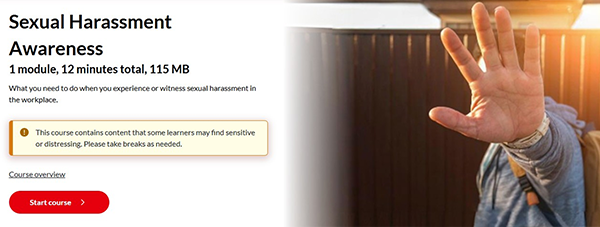
SBSUK, Sharp’s sales base in the UK, treats the creation of a safe, inclusive, and mutually respectful working environment as a key priority. In June 2025, SBSUK introduced a sexual harassment prevention policy with the aim of maintaining a safe working environment for all employees and protecting them from inappropriate behavior. This policy makes clear Sharp’s stance against harassment and provides easy-to-understand procedures for employees to report concerns and seek necessary support. Also, SBSUK has established a system to ensure that employees who have experienced or witnessed inappropriate behavior can speak up with confidence and receive an appropriate and considerate response. To promote understanding of the policy and improve its effectiveness, SBSUK conducted mandatory training for all employees. This training provided opportunities to learn about the definition of sexual harassment, specific workplace examples, recognition and prevention of inappropriate behavior, procedures for reporting concerns, appropriate online behavior, and more. Furthermore, recognizing the important role that managers play in establishing workplace standards, preventing problems, and responding appropriately when problems occur, additional training was also conducted for managers. Through clear policies, practical guidance, and targeted training, SBSUK fosters a workplace culture where all employees feel safe, respected, and comfortable speaking up. Through these efforts, employees receive ongoing support, which helps to maintain and improve a workplace environment where everyone can work positively.

Human Rights Due Diligence
Promotion System
The Sharp Group, under the oversight of the Sustainability Committee chaired by the president & CEO, and in cooperation with the ESG, human resources, procurement, compliance, and other departments, is implementing initiatives that foster respect for human rights.
The ESG department leads the design, operation, and monitoring of human rights due diligence, as well as the development of policies and measures and information disclosure. The human resources department is responsible for labor management matters and carries out the development, education, and dissemination of internal human rights policies.
The procurement department works to identify, prevent, and mitigate human rights risks in the supply chain through the implementation of the code of conduct for suppliers and responsible procurement activities. The compliance department supports efforts to address human rights risks through the operation of grievance mechanisms, including reporting and consultation processes, support for legal and regulatory compliance, and advice on serious cases.
Important issues related to respect for human rights, such as the consideration of measures to mitigate and address adverse human rights impacts identified through human rights impact assessments, are considered by relevant departments under the coordination of the ESG department. These matters are reported to and discussed by the Sustainability Committee as necessary. Furthermore, matters requiring deliberation and oversight by the Board of Directors will be reported to the Board of Directors.
Implementation of Human Rights Due Diligence
We regularly identify and assess the impacts of our business activities on human rights, consider and implement measures to prevent and mitigate adverse impacts, and disclose information based on the United Nations Guiding Principles on Business and Human Rights and the OECD Due Diligence Guidance for Responsible Business Conduct.
Identification and Impact Assessment of Human Rights Risks
We have identified areas in our business activities and supply chain that may have adverse impacts on human rights, and have identified 13 major human rights risks. In identifying risks, we organized them according to business field, region of business activity, and risks specific to the company, comprehensively evaluated the likelihood of occurrence and severity, and then considered issues that should be addressed on a priority basis.
When evaluating, we refer to RBA SAQ and VAP audit results, knowledge gained through industry activities, and human rights guidance for companies issued by governments and industry organizations.
Going forward, we plan to hold dialogues with stakeholders. Regarding any major human rights risks that we identify, we will continue to monitor progress in cooperation with relevant departments, and will strengthen our understanding of human rights risks in the supply chain, raise awareness of grievance mechanisms, and provide education and awareness-raising activities for employees and business partners. Additionally, we will regularly review our priority issues and countermeasures in light of changes in the business environment and social demands.
Stakeholder Engagement
We strive to understand external perspectives on human rights risks through dialogue with labor unions, business partners, local communities, investors, NGOs, and outside experts. The opinions and insights gained through these dialogues will be reflected in the design of human rights due diligence, the review of priority issues, and the improvement of grievance mechanisms.

Identified Risks and Adverse Impacts
| Human Rights Risk Categories | Examples of Potential Adverse Impacts | Stakeholders | Sharp’s Initiatives | |||
|---|---|---|---|---|---|---|
| Sharp employees | Supplier employees | Customers | Local communities | |||
| Child labor and young worker protection | Employment of persons below the minimum legal working age, assignment of young workers to hazardous work, obstruction of educational opportunities | ● | ● | Efforts related to human rights | ||
| Forced labor and human trafficking | Restrictions on freedom of movement or the freedom to leave employment, burden of recruitment fees, improper retention of identification documents | ● | ● | Efforts related to human rights | ||
| Discrimination and harassment | Disadvantageous treatment based on attributes and other factors; harassment in the workplace, during transactions, or when providing services | ● | ● | ● | ● | Preventing workplace harassment |
| Hotline for compliance issues | ||||||
| Working hours, rest periods, and leave | Long working hours, excessive overtime or consecutive workdays, and insufficient rest periods or days off | ● | ● | Activities to support work-life balance | ||
| Occupational safety and health | Workplace accidents; health damage caused by chemicals, equipment, etc.; shortages of safety education and protective equipment | ● | ● | Promoting occupational safety and health | ||
| Wages and benefits | Failure to ensure minimum wage, failure to pay overtime wages, inappropriate wage deductions | ● | ● | Labor–management relationship | ||
| Environmental and community impacts | Impact of chemical spills, wastewater, exhaust fumes, waste, etc., on the health and living environment of local residents | ● | ● | ● | Environmental initiatives | |
| DEI and equal opportunity | Disadvantages and limitations on participation opportunities due to insufficient consideration of age, gender, nationality, disability, etc. | ● | ● | Developing DEI-focused management | ||
| Product safety and health impacts | Product accidents, insufficient disclosure of information on chemical substances contained in products, and provision of products and services that affect health | ● | ● | Managing chemical substances contained in products | ||
| Ensuring product safety | ||||||
| Human rights impacts associated with the use of technology and AI | Discriminatory decisions, opaque decisions, and disadvantages to users resulting from the use of AI and data | ● | ● | Corporate R&D initiatives | ||
| Information security and privacy | Inappropriate acquisition, use, provision, or disclosure of personal information; infringement of privacy | ● | ● | ● | ● | Information security |
| Bribery and corruption | Bribery, improper provision of benefits, involvement in illegal transactions | ● | ● | ● | ● | Preventing corruption in all forms and dealing properly with donations |
| Access to remedy | Barriers to accessing grievance mechanisms and consultation services, retaliation against complaints, and inadequate corrective and remedial measures | ● | ● | ● | ● | Promoting CSR across the entire supply chain |