Making Easier-to-Use Products
Making Easier-to-Use Products
Practicing User-Centered Design
We practice user-centered design (UCD) in order to provide products that customers find easier to use.
The aim of UCD is to provide products and services that satisfy customers by seeing things from their perspective. We study exactly what makes products easier to use and incorporate this into product design. The UCD concept is outlined in the international ISO 9241-210 standard. We have our own UCD Basic Policy and the Eight Principles of UCD based on this concept and share them across the Sharp Group. We investigate customers’ latent dissatisfaction and needs as part of our product development process and reflect those findings in the specifications and design of our products. By repeatedly going through evaluations and improvements, we are bringing forth products and services that customers find easy to use and attractive.
For more information on our UCD-related efforts and specific examples of our products designed with ease of use in mind, please visit the Sharp User-Centered Design webpage.
Flow of Customer-Oriented Manufacturing

Customer-Oriented Manufacturing
In user-centered design (UCD), we collect customer feedback on ease of use through various methods and apply it to product design.
Through usability tests*, questionnaires, interviews, and opinions gathered from customers during Customer Assistance Center phone calls and repair visits, anonymous information from customers is compiled and shared among Sharp development personnel, who put it to use in new product design.
In support of these activities, we have established a usability engineering training program (beginners to advanced levels) to raise employees’ awareness of the importance of product usability and provide a practical, specialized curriculum that ensures they continue to maintain and improve their skills and motivation.
- Tests that involve observing how people use Sharp products and services.
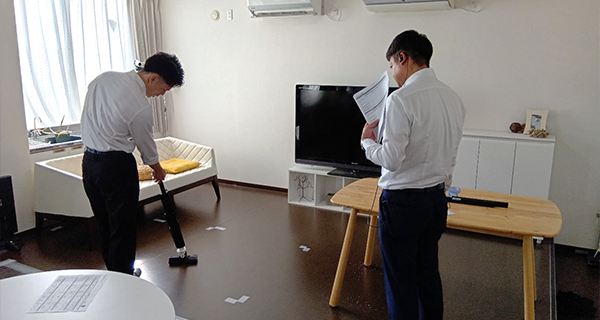
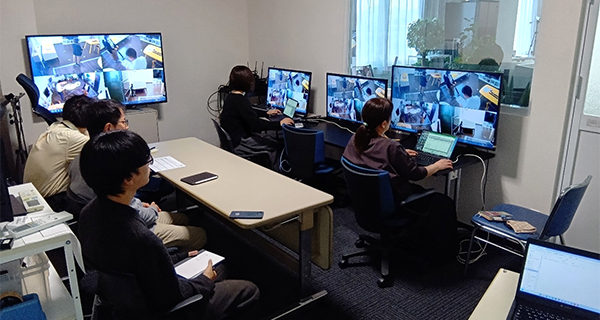
Comments from Participants in Usability Tests
- Conducting usability testing provided us with insights and revealed issues that tend to be overlooked in prototypes during the development phase. (Sharp product planning staff member)
- Evaluating ease of use in the early stages of development, and then reflecting that in the design structure, was extremely beneficial, and I realized usability testing was essential to creating better products. (Sharp product planning staff member)
Efforts in Accessibility and Universal Design
In line with the UCD Basic Policy, we also pursue accessibility and universal design (UD). These efforts are rooted in a philosophy of building products, information, and environments so that they can be used by many more customers—regardless of things like nationality, age, gender, or disability. We strive to develop products and services that can be used comfortably by as many people as possible by conducting evaluations and surveys of mainly home appliances and digital multifunction printers (MFPs).
As of May 2026, our efforts have produced 18 categories of Sharp home appliance products that support the UD considerations listed on the website of the Association for Electric Home Appliances in Japan.


To continue the aforementioned activities company-wide, we work to foster human resources through training. The training focuses on accessibility and universal design, and is conducted within a usability training system providing specialized education. Introduction to universal design (e-learning), which is mainly aimed at imparting understanding and acquisition of basic UD knowledge, has been completed by a cumulative total of approximately 6,700 employees (as of April 2026). As well, to deepen understanding of the needs of users with disabilities, there is UD experience learning where employees see firsthand what it’s like to have physical disabilities so that they can know how to make products more accessible, workshops where employees and users with disabilities discuss and brainstorm product accessibility ideas, and events on accessibility.


An online dialogue and brainstorming workshop with people with hearing impairments
Comments from Participants in Workshops
- As I had never had the opportunity to talk directly with people with disabilities before, this was an extremely valuable opportunity to hear about their daily lives in detail. (Sharp development staff member)
- I came to understand how examining in depth the difficulties faced by people with disabilities ultimately leads to products that are easy to use for everyone. (Sharp product planning staff member)
Efforts to Ensure Accessibility
Accessibility is the concept of making products and services so that they can easily be used by people who are in some way limited in their physical functions; for example, older adults and people with disabilities.
Under U.S. federal law*1, federal agencies purchasing equipment and services are obligated to choose those that are accessible to everyone, regardless of restrictions.
For Sharp digital MFPs and other products, assessment results of accessibility standards stipulated by federal law are compiled on a product evaluation sheet (VPAT*2), which is disclosed on the website of Sharp Electronics Corporation (SEC), Sharp’s U.S. sales company.
- Section 508 of the Rehabilitation Act.
- VPAT: Voluntary Product Accessibility Template. A table containing information regarding how a particular product or service conforms with Section 508 of the U.S. Rehabilitation Act.


Example of VPAT for a digital MFP
Outside Praise for Product Development Prioritizing Ease of Use
As discussed earlier, we at Sharp are committed to creating user-friendly and easy-to-understand products based on the principles of user-centered design. Products created through these efforts have received outside recognition for their ease of use, functionality, and design, leading to the receipt of such awards as the Good Design Award, high ratings in consumer electronics evaluation projects, and other positive recognition.
One example is the ES-8XS1 Plasmacluster front-loading washer/dryer, which was selected as one of the Good Design Best 100 in the 2025 Good Design Awards, organized by the Japan Institute of Design Promotion. In addition to energy efficiency and compactness, the product was designed with ease of use in mind, including features that make doing daily laundry less burdensome, as well as improving the size and position of the door and control panel.
Going forward, we will continue to develop products and services that are both easy to use and appealing to a wider range of people and that are held in high regard.
